
Electronic Press Kit
Washed up

*This page will be updated as assets + press become available*
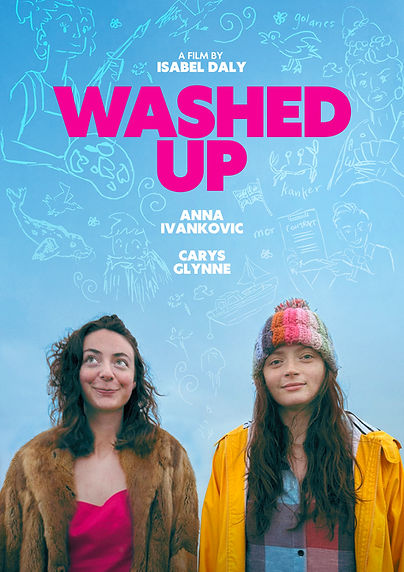
Poster: RYVE Creative
Photo: Christina SIngleton
Illustrations: Issy Brett
Download PDF Version
Download Photo & Video Assets Only
Download Press Release
PR Contact: Gwyn Thomas
Director: Isabel Moncloa Daly
Writers: Issy Brett, Carys Glynne, Isabel Moncloa Daly
Starring: Anna Ivankovic, Carys Glynne
Production Companies: Maximalist Productions, Aki Studios London
Genres: Comedy, Fantasy, Romance, LGBTQ
Run time: 85 minutes
Language: English, Cornish
Company Contact: Maximalist Productions
Logline: In coastal Cornwall, a wannabe artist struggling to keep her family home accidentally falls in love with a nomadic Selkie shapeshifter.
Synopsis
In the seaside village she calls home, Morwenna (Anna Ivankovic) - also known as “Scummy” (a bad Cornish joke) - is reeling from a breakup, navigating the impending sale of her house after the death of her grandfather, and struggling to make ends meet as an artist. In walks Inga (Carys Glynne), a strange fur-clad woman passing through the area. But after an awkward one-night stand, Scummy discovers that Inga isn’t exactly a woman at all: she’s a Selkie, a creature from Celtic mythology who shifts from seal to person by taking on and off their fur coat. Soon enough, Scummy is caught up in a whirlwind situationship with someone whose feelings are as fickle as the sea. It’s a kooky, bittersweet tale of learning to let go of the people and places you love most.

Meet The Team

Washed Up was made by a primarily female creative team and meets the standards set out by ReFrame for a production engaging in gender equity practices.

ISABEL MONCLOA DALY

Director, Co-Writer
Isabel Moncloa Daly is a writer and director raised between New Jersey and London. A graduate of Columbia University, she has written for Buzzfeed and as well as a number of podcasts via FRQNCY Media, including Tomorrow Is The Problem, A Matter of Degrees, More Than This, and Once Upon a Playtime.

CARYS GLYNNE
Producer, Co-writer, Actor, Editor
Carys’ acting credits include commercial campaigns for brands like Holland & Barrett, Sky Mobile, and Amazon Prime, as well as a slew of independent short and feature films. Her company, Maximalist Productions, is based between her hometown of Starkville, Mississippi and London, aiming to create high-concept, genre-blurring narratives on efficient budgets. She is also a co-producer on the upcoming feature film Othermor and docuseries Tallahatchie. Carys holds a B.A. from Columbia University.

ISSY BRETT
Co-writer, Art Department, Animator
Issy Brett is a writer, filmmaker and researcher currently based in Oxford, UK. She started out making student films during her BA in Chinese Studies, then continued to work on short animations while she completed an MPhil in film and animation studies at the Hong Kong University of Science and Technology. After working in tech for a few years alongside her role as co-writer and animator of Washed Up, in 2025 Issy began her PhD thanks to a Clarendon Scholarship from the University of Oxford. Her research focuses on disrupted boundaries between the human and non-human in contemporary Chinese literature and visual culture.

LILY GRIMES

Director of Photography
Lily shoots feature films, shorts, documentaries and films with artists. Drawing on an international background in news and documentary she has shot drama run and gun as well as successfully managing large camera, lighting and grip teams. Her films have won an RTS, been selected by Cannes Film Festival and competed at over 90 film festivals garnering dozens of awards. She has an MA in Cinematography from the National Film & Television School.

ANNA IVANKOVIC
Actor
Anna Ivankovic is an award-winning English actress and First Class BA (Honors) graduate of East 15 Acting School. Her work spans stage and screen, earning multiple Best Actress nominations and a win at the Stockholm City Film Festival for Not Too Far Away From Paradise. She recently completed her second feature film as the lead, Under The Bypass, a forthcoming thriller/horror now in post-production.

CROOKED WORLDS
Composer
The fantasy composing duo Crooked Worlds is made up of Alba Allan Torriset and Oliver Thomas. Alba is a British-Norwegian singer,/songwriter who has graced the stages of some of the most prestigious festivals in the UK, including Glastonbury, as well as international events such as The America’s Cup and The Extreme Sailing Series. She writes for the project Ålesund, who have amassed 700+k Spotify streams on their latest EP and have drawn praise from industry tastemakers such as BBC Introducing, CLOUT and RTE. Oliver Thomas is a platinum record award-winning and Billboard #1 selling music producer, mix engineer, composer, and multi-instrumentalist. During his 20 years as a professional musician he's worked with artists across the world in a collaborative and production capacity and has composed for film, television, theatre, gaming, podcasts, advertising, corporate, and live comedy. His music has featured on most of the uk and global network channels.
Social Media Links



Press Coverage
Interviews






Reviews

"Such a feel good film and the comedy is impeccable"


"Washed Up is a wholly unique outing from Isabel Daly that’s beautifully carried by Ivankovic and Glynne"
- Andrew Murray (RT Approved Critic)

"It manages to balance tone brilliantly to become a bittersweet story about very real, human issues"
- Danielle Meager
"Ivankovic and Glynne’s chemistry is a sensation that can be felt through the screen"
- Hailey Passmore
BFI Flare Lineup & Most Anticipated








Festivals & Awards
.png)


Film Stills


Behind-the-Scenes


Frequently Asked Questions
01
Where did the idea for the story come from?
02
What was the casting process like?
03
What’s the connection to Cornwall? How important was the setting and community?
04
What’s up with Inga’s accent?
05
How long did it take to film?
06
What was the budget and how was the film financed?
07
What are Selkies?
08
Was there any rehearsal or on-set improvisation?
09
Where did you find the music for the film?
10
How did the three writers meet?
One of the writers, Issy Brett, grew up visiting her mum’s family in the same Cornish village where we shot the film. She’d had the idea for a queer Selkie story in Cornwall for quite a long time, and when the three of us (Carys, Issy, and Isabel) decided we were ready to team up for a feature, we decided to use this concept and location as our jumping-off point. All three of us have had a love for mythology and magic since we were young.
We made sure to utilize the local casting forums for Cornwall and Devon as well as national ones like Backstage. For Scummy, we did a round of self-tapes and then an in-
person callback, since the chemistry between the characters is so crucial to the story. Anna Ivankovic was the only person who moved Carys to tears in the audition, and her casting was one of the best decisions we made in this project. The other actors all came from the Southwest and were auditioned via self-tape. Tamara and Isaak, who play the other Selkies, are local to the Lizard Peninsula itself, where we filmed.
While writer Issy was very familiar with Cornwall, having done a short stint in primary schoolthere and grown up visiting family, the rest of us were very cognizant of doing our research and trying to authentically engage with the people and culture. Cornwall Council provided ourCornish translations, the Cornish Camera Co was a huge help with gear, and Falmouth University was a partner in connecting us with student crew members via their microinternship scheme. Having grown up in a different rural region (Mississippi), co-writer Carys felt thatScummy’s conflict of loving her home but feeling stifled for job opportunities as a creative and connection with other young people was relatable to her and would be for young people all over the world in similar conundrums.
We decided that Inga’s native tongue is a faerie language, a bit like Tolkein’s Elvish inthat it combines Gaelic and Nordic influences, so she speaks with the slight formality ofa very good ESL speaker. Actually, Carys created enough of this language to translate the song at the beginning, which is based on a Cornish poem but is actually sung in the made-up Selkie language. You may also notice Inga goes on a bit of an accent journey, adopting some of Scummy’s Englishisms as she spends more time with her, and sounding least like herself at her lowest point.
We had 12 days of principal photography, followed by a handful of additional photography half-days scattered throughout the post production process. We began writing in March of 2024, began fundraising in May, casting in June, and were on set by September.
The budget was very, very low. We did a round of crowdfunding at the outset, which was an extremely daunting process, but which allowed us to move into production. We ended up with significantly less than we were aiming for and had to make a decision whether to postpone or proceed. I think we all knew if we didn’t do it then, we never would. And as hard as it was, I think we’re all very glad we did.
Selkies are mythological creatures of mostly Scottish and Irish origin, though they also appear in Iceland and some other Nordic stories. They are seals who can become human, and whose skins or coats are what allows them to live as both. They are usually depicted as women, though male Selkie stories do also exist. Their stories are often tragic, with the Selkie being forced to live on land exclusively as a human with a husband, though eventually they usually manage to steal back their skins and escape back to the sea.
We had a pretty tight window from writing and fundraising into production, and none of our cast was local to London where Isabel and Carys were based at the time, so rehearsal was more limited than Isabel would’ve preferred. Still, we had a zoom table read with the full cast, and an in-person session with Isabel, Anna and Carys to choreograph a few key scenes that would inform the dynamic. There was a fair bit of improvisation on-set, some of which was simply smoothing out the dialogue between actors and director before beginning to shoot, some of which was true impromptu lines. Some of our favorite jokes of the film were actually improvised!
Music was at the front of our minds since the beginning. Issy had put us onto the music of Mantaraybryn, a Cornish alt-pop artist whose song “No Economy” perfectly encapsulated the themes of the film. Portuguese-London group Rossana’s song“Seaside Baby” was also too on-theme to miss, so both of these songs were baked into the script before shooting. We were also fortunate enough to borrow the voices ofCornish men’s choir Oll An Gwella, who sing Harry Glasson’s “Cornwall My Home” and “Little Eyes,” London punk-revival The Rizz with “Love Smugglers,” “National Situation,”and “Son of a Victim,” and many more. And let’s not forget our fantastic original score made by Crooked Worlds Music, whose ethereal vocals and manic percussion gives the audio landscape a through-line of wonder, anxiety, and quirkiness.
Carys and Isabel went to Columbia University together and began collaborating on student film and theater productions, while Carys and Issy met on a student film at Oxford during Carys’ study abroad. The three formed a virtual writing group, nicknamed the Inklettes, in 2019.Crazily, the three of us weren’t physically in the same room until the first day we got to Cornwall for filming!
Director's Statement
Washed Up, at its heart, explores the difficulty of saying goodbye. Set in a rapidly gentrifying town in Cornwall, it follows an aspiring painter/drug dealer who falls in love with a woman who has a) commitment issues and b) a tendency to turn into a seal.While the film revolves around a toxic romantic love, Washed Up only exists because of genuine platonic love.
Back in 2019, my dear friends Issy Brett, Carys Glynne and I formed a writers group called the “Inklettes” (a reference to the Inklings, a writing group at Oxford with members like JRR Tolkien and CS Lewis). Early on, Issy had an idea for a queer love story between a Selkie and a girl in Cornwall, and while it took on different forms over the years, Carys believed it had the potential to be an indie movie, and encouraged the three of us to make it ourselves. For months, we workshopped the script. Brett created the rich characters and tone, Carys developed a more traditional plot structure, and I mainly tried to get things under budget.
Constraints fuel creativity, and Washed Up proved no exception. After we locked down the script, I spent a month in pre-production with our incredible DP, Lily Grimes, going over ways we could create compelling images with minimal equipment. We pulled a lot of visual references from unlikely sources: advertisements, paintings, magazines, vintage postcards. I picked a saturated colour palette for the costumes, with Inga and Scummy each associated with a primary colour. We studied a lot of films from the 30s and 40s to figure out how to create a dynamic scene with minimal coverage.
From the beginning, it was important that this wouldn't be a coming out story. both Inga and Scummy are comfortable in their identities before the movie begins, as are their respective communities. The conflict stems not from homophobia, but from regular relationship challenges: insecurities, communication, and worries about long-term compatibility.